
Kazimierz Krakow (2026): Jewish Quarter Guide
Kazimierz is the part of Krakow that many people remember most, as it was one of the great centers of Jewish life in Europe for centuries. Today, its old synagogues stand next to cozy cafés, small galleries and a busy market square.
In this guide, we’ll cover Szeroka Street, the synagogues you can visit, Plac Nowy and the short walk over the river to the former ghetto. You’ll also find ticket prices, opening hours and the Saturday rule that surprises many people.
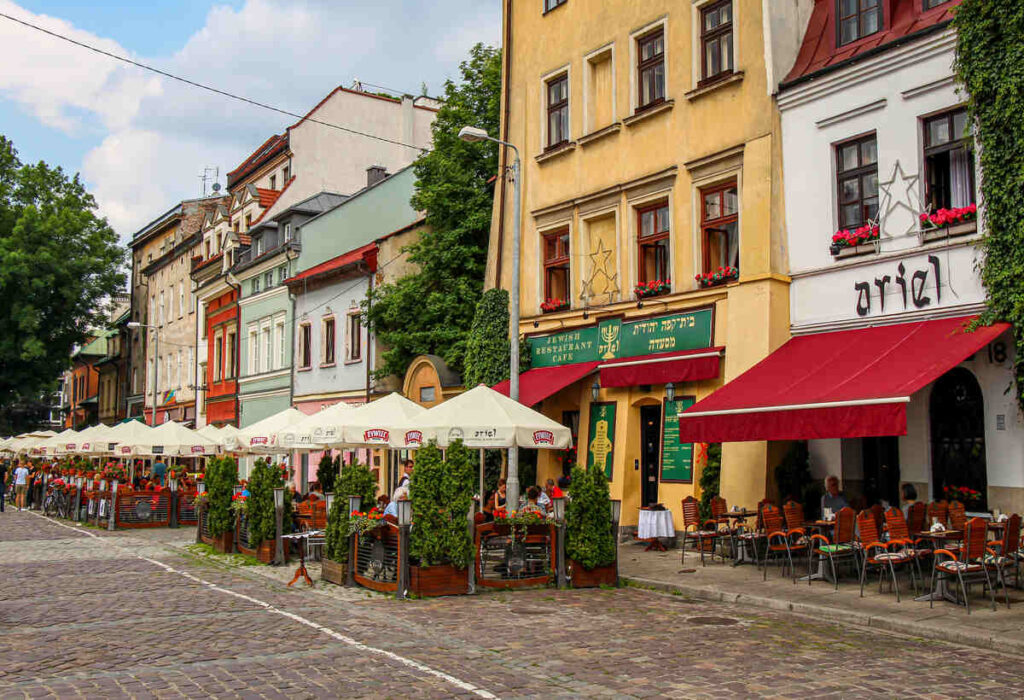
In Short
- Kazimierz is about 20 minutes on foot from the Main Square, and you can see the heart of it in half a day.
- The Old Synagogue costs 22 PLN and is free on Mondays, and the Remuh and Tempel synagogues ask for a small donation.
- The working synagogues close on Saturdays and Jewish holidays, but the Old Synagogue and the Galicia Jewish Museum stay open.
- In winter, the synagogues close at 4:00 PM, and on Fridays they close two hours earlier.
- The wartime ghetto was in Podgórze, not Kazimierz, and it’s a short walk away over the Father Bernatek Footbridge.
Join Our Facebook Group
Planning a trip to Auschwitz, Krakow or Warsaw? Ask questions, swap tips and share your plans with other people heading to Poland. It’s free to join.
In This Guide
- What Is Kazimierz? Krakow’s Old Jewish Quarter
- How to Get to Kazimierz From the Main Square
- Kazimierz Synagogues You Can Visit: Prices and Hours
- Visiting Kazimierz on a Saturday or a Jewish Holiday
- Szeroka Street and the Schindler’s List Filming Spots
- Plac Nowy and Where to Eat in Kazimierz
- Corpus Christi Basilica and Catholic Kazimierz
- Galicia Jewish Museum in Kazimierz
- The Krakow Ghetto in Podgórze, a Short Walk Across the River
- Kazimierz Walking Route for Half a Day
- Kazimierz Guided Tours
- Is Kazimierz Worth Visiting?
- FAQ
What Is Kazimierz? Krakow’s Old Jewish Quarter
Kazimierz was once a separate town, founded by King Casimir the Great in 1335. In the Middle Ages, it was one of the most important cities in Poland, and it only became part of Krakow in 1800.
Late in the 15th century, the Jews of Krakow were moved into the northeast corner of Kazimierz. The Jewish town grew around Szeroka Street, and it became one of Europe’s great Jewish centers. Just before World War II, about 60,000 Jews lived in Krakow, which was roughly a quarter of the city.
Most of them were murdered in the Holocaust. After 1989, Kazimierz slowly came back to life, with galleries, restaurants and a small Jewish community again. As you walk around its streets, you’ll notice both parts of this story side by side.
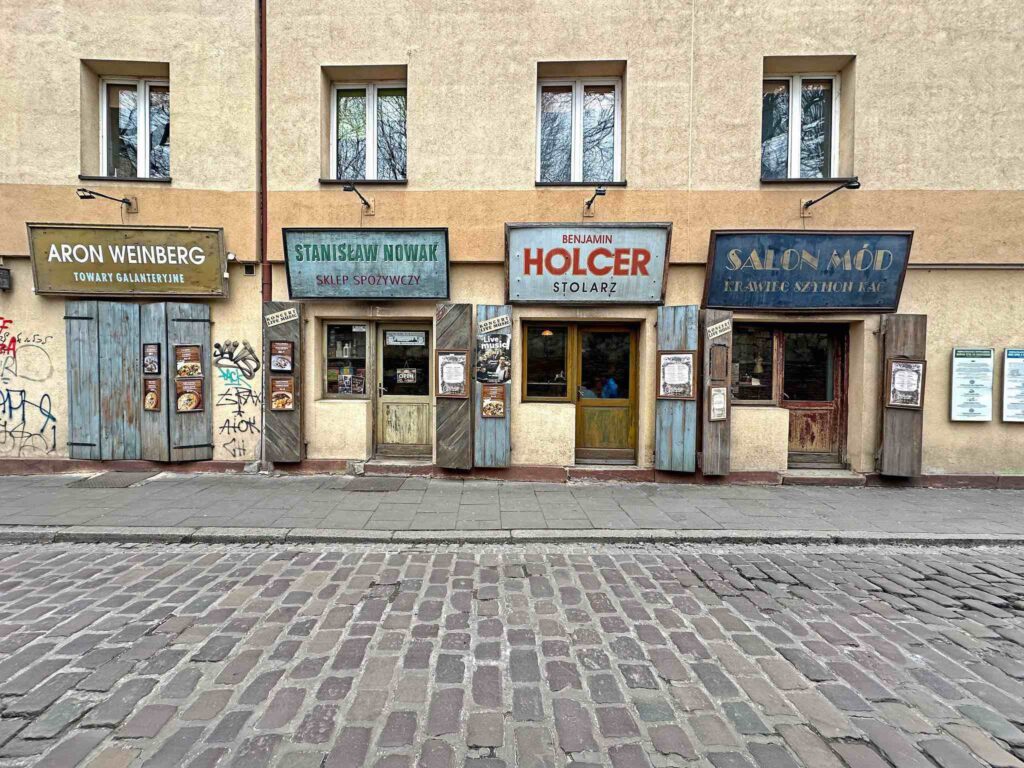
How to Get to Kazimierz From the Main Square
Kazimierz is easy to reach on foot, and walking is the nicest way to arrive. From the Main Square, Szeroka Street is about 20 minutes away, and from Wawel Hill it’s about 16 minutes.
Trams also stop on the edge of the district, and a 30-minute ticket costs 6 PLN. Most people still walk, as the streets on the way are part of the fun.
Kazimierz is fairly small, so you won’t need transport once you’re there. Comfortable shoes are a good idea, though, as many of the streets are cobbled.
Kazimierz Synagogues You Can Visit: Prices and Hours
Kazimierz has seven historic synagogues, but only four of them are open to the public. Here’s a quick look at each one before you go:
| Synagogue | Entry | Saturday |
|---|---|---|
| Old Synagogue, Szeroka 24 | 22 PLN, free on Mondays | Open |
| Remuh Synagogue and cemetery, Szeroka 40 | Donation of 10 to 20 PLN | Closed |
| Tempel Synagogue, Miodowa 24 | Donation of 10 to 15 PLN | Closed |
| Isaac Synagogue, Kupa 18 | Ask at the door | Closed |
| High, Kupa and Popper synagogues | Not open inside | Closed |
Old Synagogue
The Old Synagogue was built in 1407, and it’s the oldest surviving synagogue in Poland. It burned in 1557 and was rebuilt in Renaissance style. Today, it’s a branch of the Museum of Krakow.
A ticket costs 22 PLN, or 16 PLN reduced, and entry is free on Mondays. It opens 9:00 AM–5:00 PM Tuesday through Sunday, and 10:00 AM–3:00 PM on Mondays. Most people spend about 30 minutes inside.
Remuh Synagogue and Old Cemetery
The small Remuh Synagogue dates from around 1558, and it’s still the main synagogue of Krakow’s Jewish community. It’s named after Rabbi Moses Isserles, known as the Remuh, who is buried in the cemetery behind it.
The cemetery was used from the 16th century until 1800, and it’s one of the most moving places in Kazimierz. Entry is a small donation of about 10 to 20 PLN. The cemetery closes in the middle of the afternoon, so it’s better to come earlier in the day.
Tempel Synagogue
The Tempel Synagogue was built in 1860–1862, and it looks very different from the older ones. Inside, you’ll see stained glass and a white marble ark under a golden half-dome. Entry is a donation of 10 to 15 PLN.
Isaac Synagogue and the Closed Synagogues
The Isaac Synagogue, the largest in Kazimierz, has reopened after years of restoration, and work inside is still going on. Its opening hours can change, so it’s worth checking gwzkrakow.pl before you go.
The High Synagogue on Józefa Street is closed for now, and the Kupa Synagogue is also closed to the public. The Popper Synagogue on Szeroka Street is now a bookshop, so you’ll only see it from the street.
Visiting Kazimierz on a Saturday or a Jewish Holiday
Saturdays are the one thing worth planning around in Kazimierz. The Remuh, Tempel and Isaac synagogues are working synagogues, and they’re closed to tourists on Saturdays and Jewish holidays. The two Jewish cemeteries are closed then too.
Between March and October, they’re open 10:00 AM–6:00 PM, and between November and February they close at 4:00 PM. On Fridays, they close two hours earlier than usual, and they’re also closed to tourists during prayers.
In case Saturday is your only day in Kazimierz, there’s no need to worry, as the Old Synagogue museum and the Galicia Jewish Museum both stay open. Jewish holidays fall on different dates each year, so it’s a good idea to check the community’s calendar at gwzkrakow.pl before you go.
Inside the working synagogues, men need to cover their heads, and a head covering can be borrowed at the door. Modest clothes are a good idea too, as these are places of prayer.
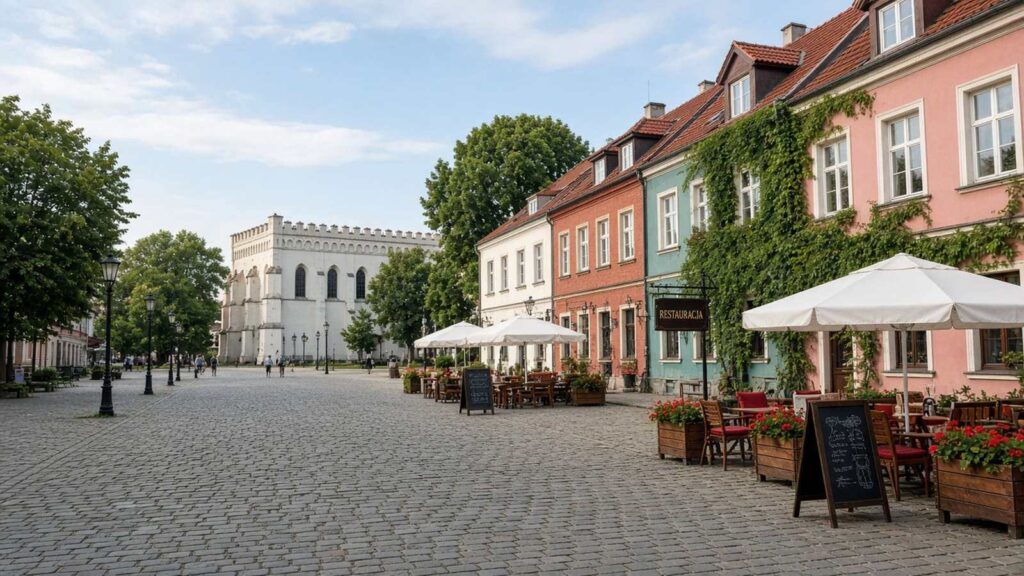
Szeroka Street and the Schindler’s List Filming Spots
Szeroka Street is really more of a long square, and it was the heart of the old Jewish town. Four synagogues once stood on this one street, which you wouldn’t find on any other street in Europe at the time.
Steven Spielberg filmed much of Schindler’s List in Kazimierz and Podgórze. Szeroka Street was used as the ghetto square in the film, and the crew built a ghetto wall and gate at its narrow southern end.
Nearby, the courtyard at Józefa 12 is another well-known filming spot. It was built as an inn in 1802, and many people call it the prettiest courtyard in Kazimierz.
Each summer, Kazimierz also hosts the Jewish Culture Festival, which has been held since 1988. It ends with the Shalom on Szeroka Street concert, when the whole street fills with music.
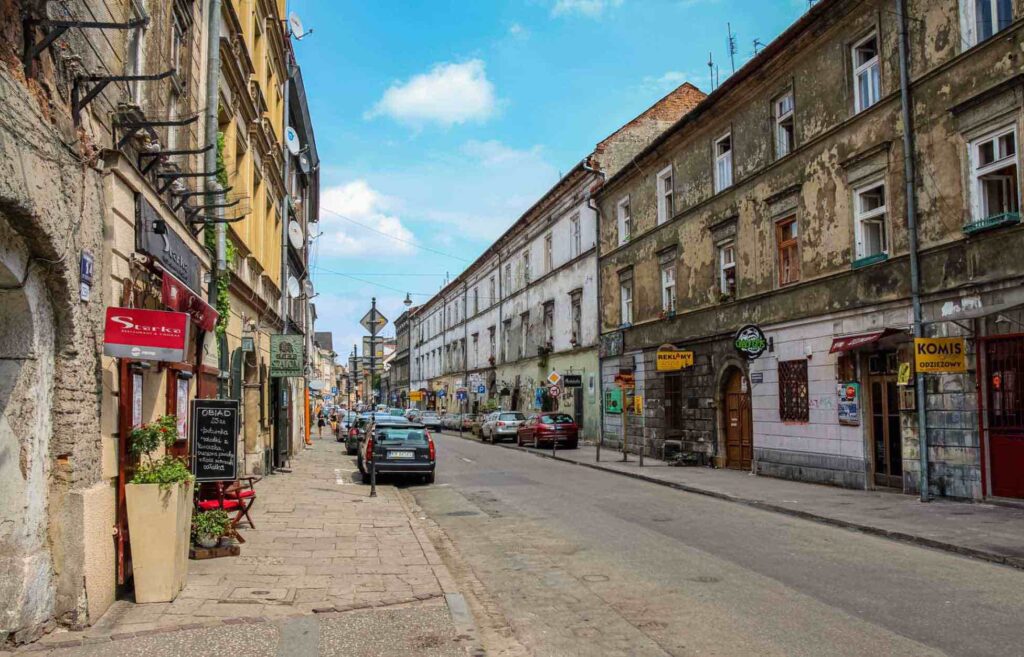
Plac Nowy and Where to Eat in Kazimierz
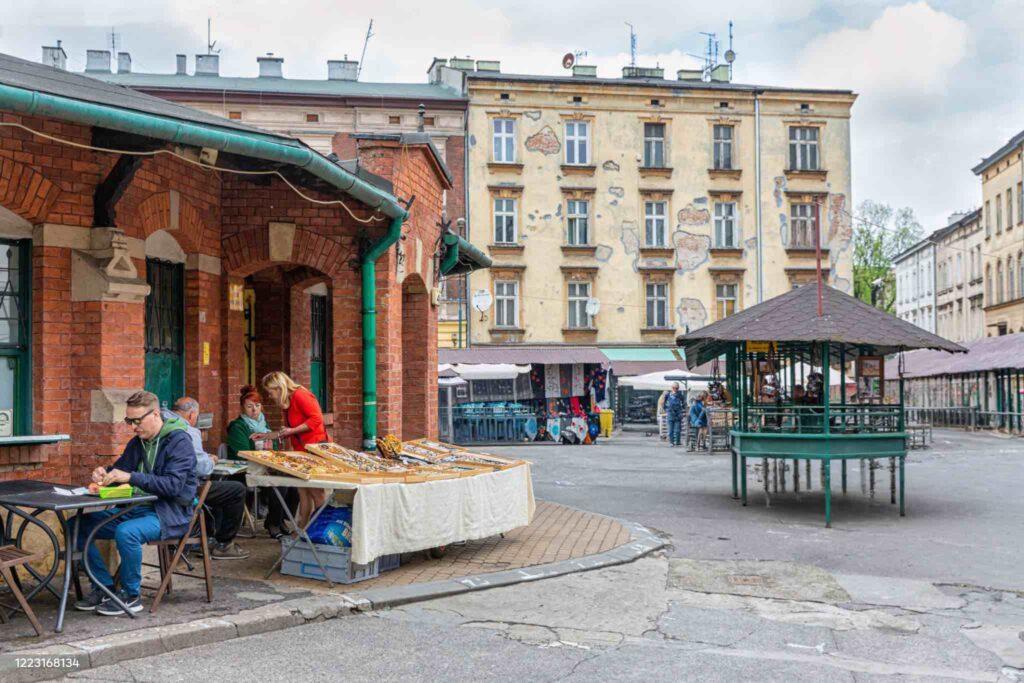
Plac Nowy is the lively little square in the middle of Kazimierz, and locals still call it the Jewish Square. A round market hall stands in the middle, with a busy flea market around it.
The market stalls open 7:00 AM–8:00 PM Monday through Saturday, and 7:00 AM–3:00 PM on Sundays. In the evening, the bars and restaurants around the square fill up fast.
Here are a few easy things to try while you’re in and around Plac Nowy:
- Zapiekanka: The classic Krakow snack after dark. It’s an open baguette with mushrooms and melted cheese, and it’s sold from the windows of the round hall.
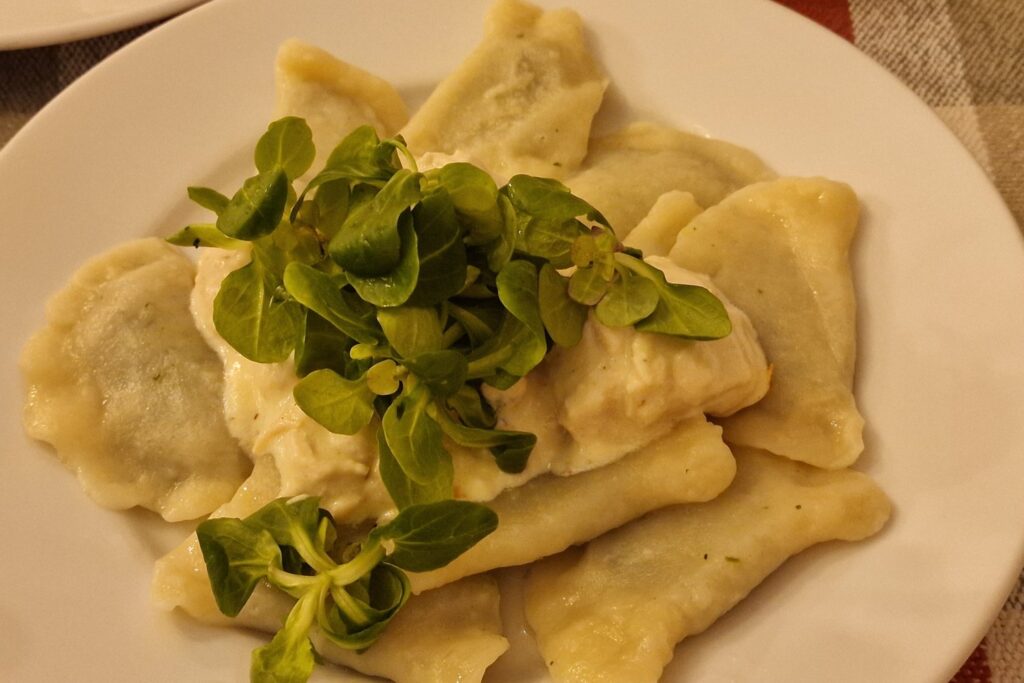
- Pierogi: The easy first choice for a proper meal. Go for ruskie, the classic filling of potato and white cheese.
- Polish and Jewish-style restaurants: The streets around Szeroka Street and Plac Nowy have plenty of places for a relaxed dinner after a day of walking.
Corpus Christi Basilica and Catholic Kazimierz
Kazimierz wasn’t only Jewish, and its big Gothic churches are well worth a look. The Corpus Christi Basilica on Bożego Ciała Street was the town’s parish church, and it’s free to enter.
It’s open 7:00 AM–7:00 PM every day, though visits are only possible outside of services. Once inside, look for the boat-shaped pulpit held up by two mermaids, and for the biggest organ in Krakow.
In 1655, the Swedish king made this church his headquarters during the siege of Krakow. That’s why the Gothic church now has mostly Baroque furnishings. St Catherine’s Church and the Skałka church are also close by.
Galicia Jewish Museum in Kazimierz
The Galicia Jewish Museum on Dajwór Street is a short walk from Szeroka Street. Its photo exhibition, Traces of Memory, shows what is left of Jewish life in southern Poland today.
A ticket costs 35 PLN, or 25 PLN for students and seniors, and the museum is open every day. There’s also a café and one of the biggest Jewish bookshops in Poland. Most people spend about 1.5 hours there.
It’s open on Saturdays, so it’s a good choice when the working synagogues are closed.
The Krakow Ghetto in Podgórze, a Short Walk Across the River
Many people expect the wartime ghetto to be in Kazimierz, but it was across the river in Podgórze. In March 1941, the Germans forced between 15,000 and 20,000 Jews into a small walled area there.
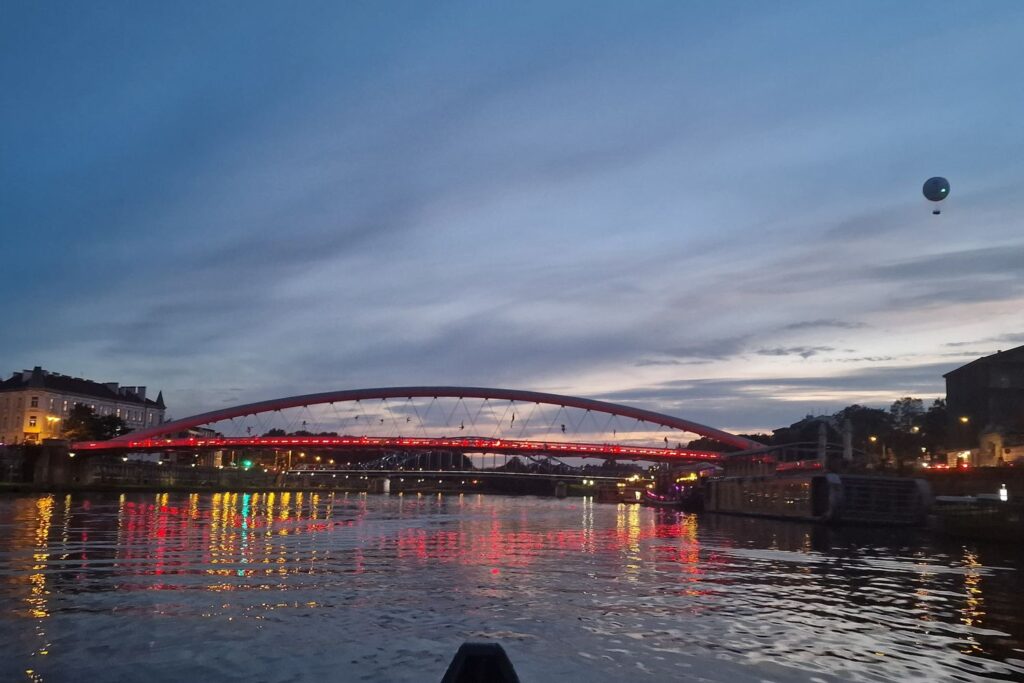
To get there, walk over the Father Bernatek Footbridge, which takes about 10 to 15 minutes from Szeroka Street. Look up as you cross, as acrobat figures hang from the cables above you.
Ghetto Heroes Square was the main square of the ghetto, and people were gathered here for deportation. Today, a memorial of large metal chairs fills the square. As it’s a memorial, it’s kind to treat the chairs with respect rather than as seats for photos.
On the square, the Eagle Pharmacy tells the story of Tadeusz Pankiewicz, whose pharmacy was the only one inside the ghetto. It opens 9:00 AM–5:00 PM Wednesday through Sunday, costs 22 PLN and is free on Wednesdays.
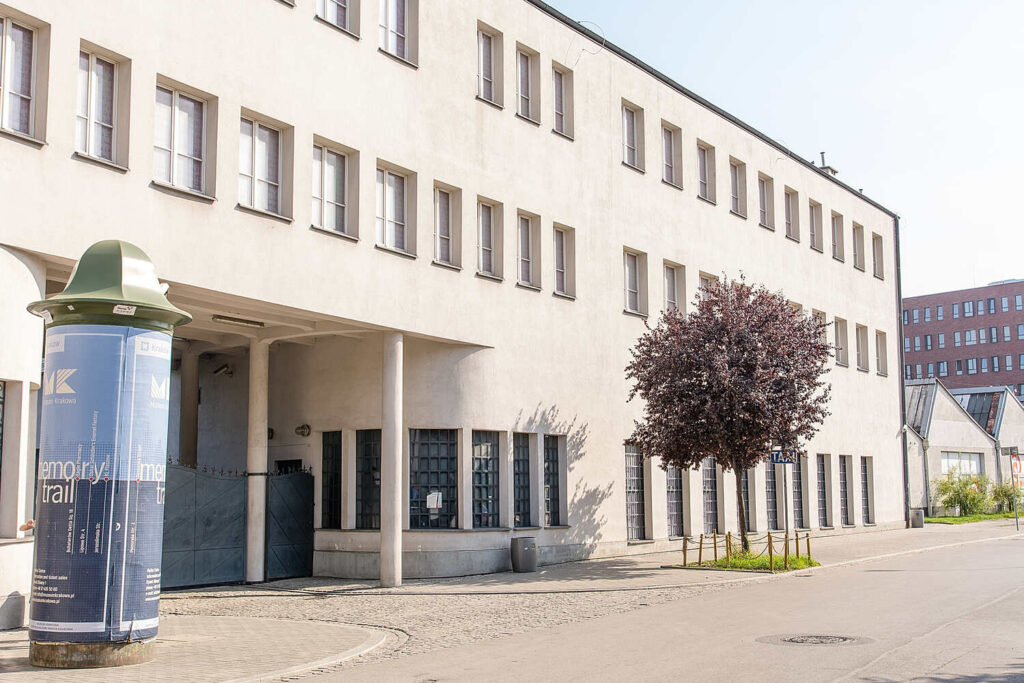
Schindler’s Factory is about 8 minutes on foot from the square. A ticket costs 60 PLN, and it’s best to book online a few days ahead. It’s closed on the first Tuesday of every month.
Kazimierz Walking Route for Half a Day
A half day is enough to see the best of Kazimierz without rushing. This simple route keeps the walking short:
- Start on Szeroka Street at the Old Synagogue.
- Visit the Remuh Synagogue and its cemetery next door.
- Walk to the Tempel Synagogue on Miodowa Street.
- Stop for a zapiekanka or lunch on Plac Nowy.
- See the courtyard at Józefa 12 and the Corpus Christi Basilica.
- Cross the Father Bernatek Footbridge to Ghetto Heroes Square.
On a full day, add the Galicia Jewish Museum in the morning and Schindler’s Factory in the afternoon. For more ideas around the city, our list of things to do in Poland covers the rest of Krakow.
Kazimierz Guided Tours
Kazimierz is easy to see on your own, but a guide can tell you the stories behind the buildings. Many people find the history makes much more sense that way.
The Krakow Jewish Quarter and Former Ghetto Tour on GetYourGuide takes about 2.5 hours. It starts at the Old Synagogue and covers Kazimierz, the former ghetto and the Schindler’s List filming spots.
To understand the whole story, many people also spend a day at Auschwitz-Birkenau, which is about an hour from Krakow. Our guide to the best Auschwitz tours from Krakow compares the options, and our Krakow to Auschwitz guide covers going on your own.
Is Kazimierz Worth Visiting?
Yes, Kazimierz is one of the places you really shouldn’t miss in Krakow. It’s moving, beautiful and lively, often all on the same street.
We’d suggest giving it at least half a day, and it’s best to avoid a Saturday if you’d like to see inside the working synagogues. A nice way to do it is to start at the Old Synagogue, walk over to Podgórze and finish with dinner on Plac Nowy.
For more ideas outside the city, our guide to the best day trips from Krakow covers 15 easy trips.
FAQ
Is Kazimierz Krakow Worth Visiting?
Yes, Kazimierz is one of the highlights of Krakow, as it was a great center of Jewish life for centuries. Its old synagogues, the Remuh cemetery and Szeroka Street are all still there, next to cafés and the Plac Nowy market. Half a day is enough to see the main places on foot.
Are the Kazimierz Synagogues Open on Saturdays?
No, the working synagogues, including the Remuh, Tempel and Isaac, are closed to tourists on Saturdays and Jewish holidays. The Jewish cemeteries are closed too, and on Fridays everything closes two hours early. The Old Synagogue museum and the Galicia Jewish Museum stay open on Saturdays, so you still have something to see.
How Much Does It Cost to Visit the Kazimierz Synagogues?
The Old Synagogue costs 22 PLN, or 16 PLN reduced, and it’s free on Mondays. The Remuh Synagogue and its cemetery ask for a donation of about 10 to 20 PLN, and the Tempel Synagogue asks for 10 to 15 PLN. So seeing all three will cost you well under 70 PLN per person.
How Far Is Kazimierz From the Main Square?
Kazimierz is about 20 minutes on foot from the Main Square, and about 16 minutes from Wawel Hill. Trams stop on the edge of the district, and a 30-minute ticket costs 6 PLN. Most people walk, though, as the route is pleasant and you won’t need any transport once you’re there.
Was the Krakow Ghetto in Kazimierz?
No, the wartime ghetto was in Podgórze, across the Vistula River from Kazimierz. In March 1941, the Germans forced between 15,000 and 20,000 Jews into it. You can walk there in about 10 to 15 minutes over the Father Bernatek Footbridge, and see Ghetto Heroes Square and the Eagle Pharmacy.
What Should You Wear to Visit the Synagogues in Kazimierz?
Men need to cover their heads inside the working synagogues, and you can borrow a head covering at the door. Modest clothes are a good idea too, as these are places of prayer. The Old Synagogue is a museum, so there are no special rules there, though comfortable shoes help on the cobbled streets.
Planning Krakow
Wawel Castle Tickets and Hours
Our guide covers Wawel’s ticket prices, opening hours and free days, so you can plan your visit to the castle too.